
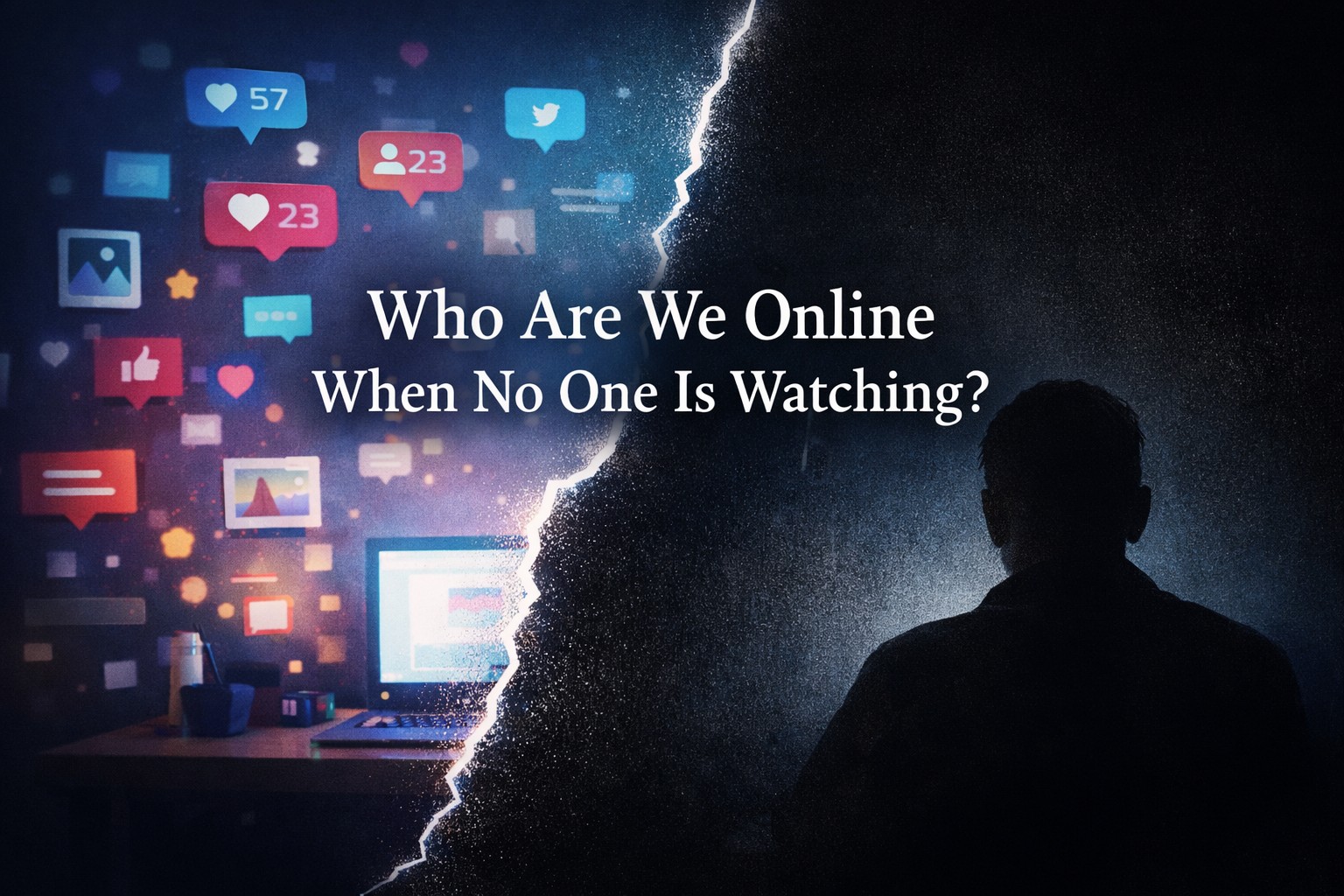
The digital age promised a playground for the soul—a place where, behind the safety of a screen, we could explore the facets of our identity without the weight of social judgment. We believed that when the physical gaze of others was removed, our “true” self would finally emerge.
Instead, we found that the gaze never left. It simply became invisible.
The Myth of Digital Solitude
In the physical world, solitude provides a sanctuary for reflection. When we are alone, we shed the performances required by professional, social, and familial circles.
Online, solitude is an illusion. Every private search, every scrolled feed, and every lingered-on image is witnessed by systems designed to categorize us. We are never “alone” because we are always being measured. The knowledge that our private behaviors are being converted into data profiles creates a subtle, subconscious performance.
We are not just who we think we are; we are who the machine concludes we are.
Identity as a Data Point
To a platform, identity is not a fluid, lived experience. It is a cluster of predictive markers.
Our “self” is reconstructed through our digital breadcrumbs: the speed at which we scroll past a political headline, the products we abandon in a cart, the late-night rabbit holes we fall into. These data points form a “digital twin”—a version of us that may be more accurate in its predictability than our own self-perception.
When the system reflects this twin back to us through recommendations and targeted content, we begin to align our real-world behavior with our algorithmic profile. We don’t just use the platform; we become the person the platform expects us to be.
The Performance of the Private
Even in “disappearing” messages or private browsing, the psychological weight of the archive remains. We have moved from a culture of forgetting to a culture of permanent recording.
Because our digital history is functionally eternal, we have developed a “preventative identity.” We curate our private selves not for the people we know, but for the invisible auditors of the future—employers, governments, or the algorithms themselves.
The spontaneous, messy, and contradictory parts of human nature are being filed away to make room for a version of ourselves that is “cleaner” and more legible to the system.
The Erosion of the Interior
Identity has traditionally been formed in the tension between our inner thoughts and our public actions. This “inner room” allowed us to test ideas and feelings before presenting them to the world.
Digital platforms collapse this distance. They demand immediate reaction. They prompt us to “share our thoughts” before we have even finished thinking them. By turning our internal impulses into external content, we lose the private space necessary for genuine self-evolution.
When our interior life is constantly exported to the digital world, the “inner room” goes dark.
Who Controls the Mirror?
If identity is a mirror, digital platforms have taken control of the glass.
They do not reflect us as we are; they reflect us in a way that maximizes engagement. They amplify our anxieties, our vanities, and our tribal loyalties because those are the traits that keep us connected.
We look into the digital screen to find ourselves, but we find a version of ourselves that has been engineered to stay online.
The Future of the Unseen Self
Reclaiming a sense of self requires the re-establishment of true digital privacy—not just as a legal right, but as a psychological necessity.
To grow, humans need the freedom to be inconsistent, to be wrong, and to be unobserved. We need a “dark space” where no data is collected and no behavior is analyzed.
The most profound question of the modern era is not how we present ourselves to the world, but whether we still have a self to return to when we log off.
Because in a world of constant surveillance,
the most radical act of identity—
is being someone who cannot be tracked.