
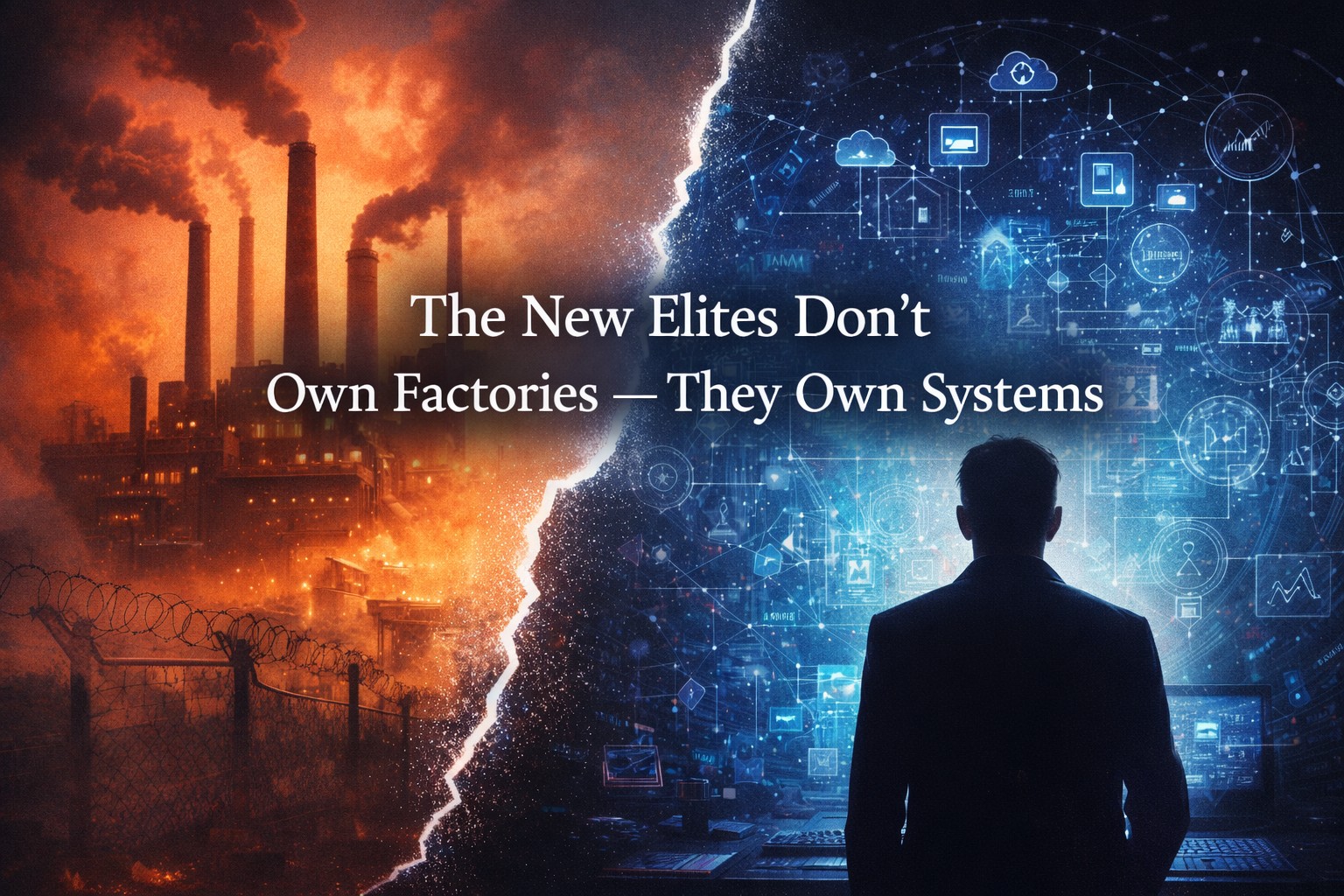
The traditional image of the “elite” is rooted in the industrial age: a titan of industry standing before a sprawling factory, a fleet of ships, or a vast tract of land. Power was synonymous with the ownership of physical assets. To control the economy, you had to control the means of production.
But in the twenty-first century, the nature of power has undergone a structural shift. The most influential actors in the modern world no longer define themselves by what they produce, but by what they orchestrate.
From Assets to Architectures
In the old economy, wealth was built through the accumulation of tangible goods. In the new economy, wealth is built through the design of invisible architectures.
The new elites are the architects of the systems—the platforms, the protocols, and the marketplaces—within which everyone else operates. They do not need to own the cars, the apartments, or the inventory. By owning the system that connects the buyer to the seller, they extract a “sovereign rent” from every interaction that occurs within their digital walls.
The Power of the Interface
Control used to be located at the factory gate; today, it is located at the interface.
The interface is the primary point of contact between a human and the global economy. Whoever controls the interface controls the flow of information, the visibility of choices, and the terms of participation. This is power without the burden of maintenance. While traditional owners must worry about depreciation, labor unions, and physical decay, the owners of systems manage code, data, and network effects.
The system doesn’t just host the market; it is the market.
Orchestration as Governance
The new elite performs a role that looks less like traditional business and more like private governance.
When a system owner updates an algorithm or changes a Terms of Service agreement, they are effectively rewriting the laws of a digital territory. These changes can instantly alter the livelihoods of millions of workers and the viability of thousands of businesses.
This is governance without a ballot box. The “citizens” of these systems—users, creators, and contractors—have little recourse when the rules change, because the system has become a necessity for survival in modern life.
The Scale of the Intangible
Physical assets have a ceiling. A factory can only produce so much; a piece of land has fixed borders.
Systems, however, scale with almost zero marginal cost. Once a protocol is established, it can encompass an entire global industry. This creates a winner-take-all dynamic where the elite are no longer just “rich”—they are foundational. They become “too big to fail” not because of their debt, but because the social and economic infrastructure of society has been built on top of their proprietary code.
The Dependency Loop
The brilliance of system ownership lies in its ability to create dependency.
In the past, if you didn’t like a merchant, you went to another. Today, the network effects of dominant systems make exit nearly impossible. If your identity, your reputation, your customer base, and your history are all locked within a specific system, leaving that system means economic or social suicide.
The new elite doesn’t force you to stay; they simply make the cost of leaving too high to pay.
Redefining the Struggle for Power
If power has moved from the factory to the system, then the struggle for fairness must move there as well.
The debates of the 20th century—over wages, hours, and working conditions—are being superseded by debates over algorithmic transparency, data portability, and interoperability. To challenge the power of the new elite is to challenge the exclusivity of the systems they own.
The question for the next generation is simple:
Will the systems that run our world be public infrastructure—
or private fiefdoms?