
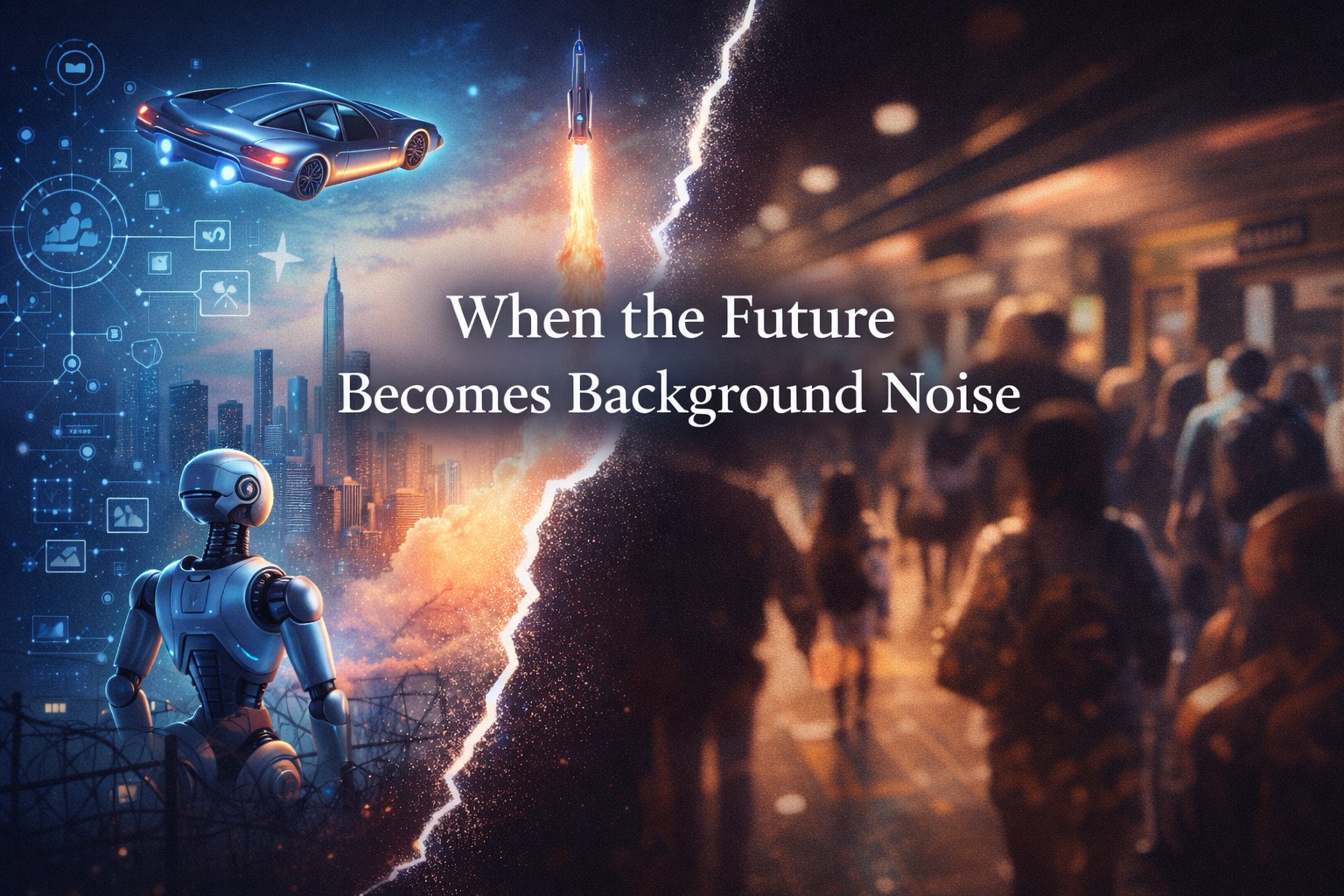
There was a time when “the future” was an event—a destination we moved toward with a mix of anxiety and wonder. We imagined a distinct moment when the world would change, marked by flying cars or sentient cities.
But the future didn’t arrive with a bang. It arrived as a software update. It arrived as a subtle shift in how we order food, how we find partners, and how we process truth. Today, we live in a state of “permanent transition,” where technological miracles have become so frequent they have faded into the background noise of daily life.
The Normalization of the Impossible
We are the first generation to experience “Future Fatigue.”
Technologies that would have seemed like magic a decade ago—instant global communication, generative intelligence, CRISPR gene editing—are now met with a shrug. We have integrated the extraordinary into our routines so quickly that we have lost the ability to be surprised.
When the impossible becomes a utility, it loses its power to inspire. We no longer look at our devices with wonder; we look at them with frustration when they lag for a second. We haven’t conquered the future; we have simply made it mundane.
The Blur of Constant Innovation
In the past, technological shifts had “breathing room.” The steam engine, the automobile, and the television each had decades to be absorbed into the cultural fabric. Society had time to build ethics, laws, and habits around them.
Today, the cycles of innovation are shorter than the human attention span. Before we can understand the implications of one breakthrough, three more have taken its place. This creates a “blur effect”—a feeling that the world is moving too fast to be steered. Instead of navigating the future, we are simply trying to keep our heads above the digital tide.
The Invisible Environment
The most powerful technologies are those that become invisible.
The more advanced a system becomes, the more it disappears into the environment. We no longer think about “using the internet”—the internet is simply the space in which we exist. We don’t think about “interfacing with AI”—it is the invisible hand that sorts our emails, manages our traffic, and curates our thoughts.
Because these systems are invisible, they are rarely questioned. We focus on the “noise” of the surface—the latest app or the newest gadget—while the underlying infrastructure of our lives is rebuilt by forces we don’t fully see or understand.
The Loss of the Horizon
When change is constant, the concept of a “horizon” disappears.
If everything is always changing, then nothing feels like progress. We find ourselves in a “red queen’s race,” running as fast as we can just to stay in the same place. This lack of a clear destination leads to a sense of aimlessness. We have all the tools of the future, but we have lost the grand narratives that tell us what to do with them.
The future is no longer a dream to be achieved; it is a series of technical requirements to be managed.
Reclaiming the Signal
To think clearly in the age of background noise, we must learn to distinguish between vibration and movement.
Much of what we call “progress” is merely the vibration of a system running at high speed—more features, more data, more notifications. Real movement is the transformation of the human condition.
If we allow the future to remain background noise, we surrender our agency to the architects of the noise. We become passive passengers in a vehicle with no one at the wheel.
Beyond the Static
The challenge of the 21st century is to stop being impressed by the speed of change and start being critical of its direction.
We must learn to look past the glow of the screen and the hum of the server. We must pull the future out of the background and back into the light of conscious choice.
Technology is not a weather pattern that we must simply endure. It is a language we are writing. And it is time we started
listening to what the silence—
is trying to tell us.