
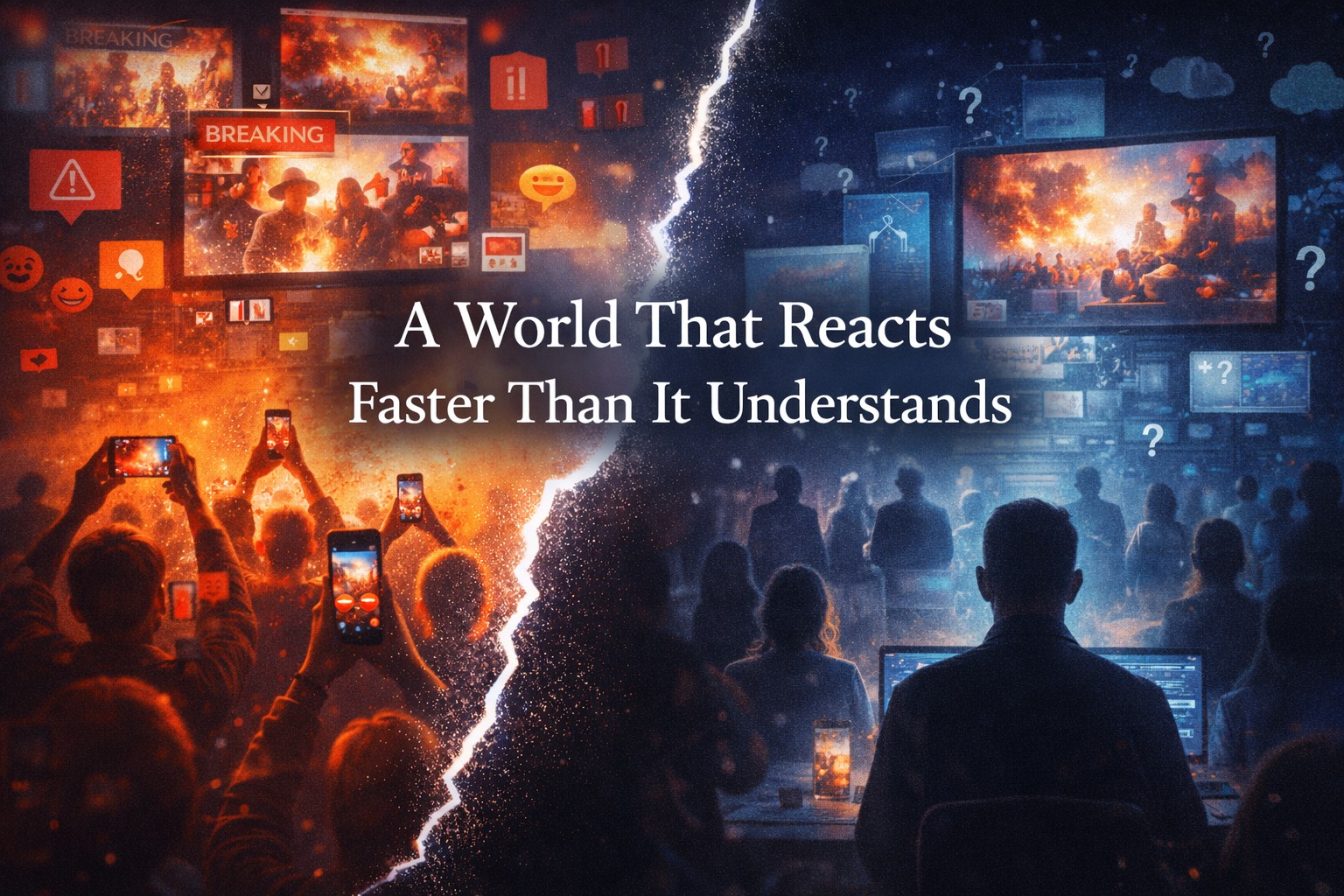
We live in the era of the “instant response.” Our global communication infrastructure has been optimized for one specific metric: speed. We have built a world where information travels at the speed of light, but human comprehension still moves at the pace of biology.
The gap between these two speeds is where our shared reality begins to fracture. We have created a society that is hyper-informed but deeply confused—a world that reacts to everything, yet understands less and less.
The Death of the Deliberative Gap
Historically, there was a physical delay between an event and its public consumption. This “deliberative gap” was essential for society. It allowed for the verification of facts, the consideration of context, and the cooling of emotional tempers.
Digital platforms have eliminated this gap. Today, the reaction is simultaneous with the event. We are prompted to have an opinion on a geopolitical crisis, a scientific breakthrough, or a social tragedy within seconds of hearing about it. In this environment, the loudest and fastest reactions win, while nuance and reflection are discarded as “too slow.”
The Reflexive Society
When speed is the priority, our responses become reflexive rather than reflective.
We no longer process information; we react to signals. We look for keywords that tell us which “side” an event belongs to, and we deploy pre-packaged emotional responses. This is the automation of human thought. We have outsourced our judgment to the immediate impulse, turning the global public square into a series of massive, uncoordinated nervous system spasms.
Understanding as an Obstacle
In a high-speed attention economy, deep understanding is actually a competitive disadvantage.
To truly understand a complex issue requires time, the admission of ignorance, and the willingness to sit with ambiguity. These are luxuries the modern digital environment does not afford. If you take the time to understand, you are absent from the conversation.
The system rewards the definitive, the indignant, and the immediate. We are incentivized to be “first” and “certain,” even when we are wrong. Understanding has become the friction that the system is trying to “optimize” away.
The Crisis of Context
Information without context is just noise.
In our rush to react, we strip events of their history and their complexity. We treat every headline as an isolated data point, a fresh spark to ignite our collective anxiety. This creates a state of perpetual presentism—a world where the “now” is so intense that the “before” and “after” no longer matter.
Without context, we cannot build a coherent narrative of our world. We are left with a fragmented reality, a chaotic mosaic of high-speed updates that never quite resolve into a clear picture.
The Velocity of Polarization
Polarization is the natural byproduct of speed.
When we react instantly, we fall back on our most basic tribal instincts. Nuance requires a slow-down; anger is a high-speed emotion. By accelerating the pace of social interaction, technology has inadvertently accelerated the pace of social division. The faster the world moves, the more we retreat into the safety of our ideological silos.
Slowing Down the Signal
Reclaiming our collective sanity requires a conscious deceleration.
We must recognize that the ability to not have an opinion is a form of intellectual power. We must protect the “right to wait”—the right to remain silent until the facts are clear and the context is understood.
The challenges of the 21st century—climate change, systemic inequality, technological upheaval—cannot be solved with reflexes. They require the slow, difficult work of comprehension.
We have mastered the art of the reaction. Now, we must relearn the art of the response.
Because in a world of instant noise,
the most powerful voice—
is the one that takes a moment to think.